


The Great Pyramids of Giza
The Pyramids of Giza are the last surviving Wonder of the Ancient World, built as elaborate royal tombs during Egypt's Fourth Dynasty (c. 2580-2510 BC). Located on the Giza Plateau near Cairo, this UNESCO World Heritage Site features three main pyramids, the Great Sphinx, and numerous smaller monuments showcasing ancient Egyptian architectural mastery.
Location: Egypt, Cairo/Giza
The Pyramids of Giza: Egypt’s Eternal Legacy
Standing majestically on the western edge of Cairo, the Pyramids of Giza have captivated humanity for over 4,500 years. Built during Egypt’s Fourth Dynasty, these monumental structures represent the pinnacle of ancient Egyptian architectural achievement and remain the most recognizable symbols of one of history’s greatest civilizations. The Giza Necropolis, a UNESCO World Heritage Site since 1979, encompasses three main pyramids, the enigmatic Great Sphinx, several smaller satellite pyramids, temples, and causeways that once formed an elaborate complex dedicated to the pharaohs’ journey to the afterlife.
The construction of these colossal monuments occurred during what historians call the Old Kingdom period, often referred to as the “Age of the Pyramids.” Between approximately 2580 and 2510 BC, three successive pharaohs—Khufu, Khafre, and Menkaure—transformed the Giza Plateau into an eternal resting place that would defy time itself. Today, the pyramids continue to inspire wonder, standing as testament to ancient Egypt’s organizational capabilities, mathematical precision, and unwavering belief in the afterlife.
The Great Pyramid of Khufu: The Last Wonder Standing
The Great Pyramid of Khufu, also known by his Greek name Cheops, dominates the Giza Plateau as the largest and oldest of the three pyramids. Constructed around 2580 BC over an estimated 20-year period, this architectural marvel originally stood 146.5 meters tall, though erosion and the loss of its smooth white limestone casing stones have reduced its height to approximately 138.8 meters today. For nearly 4,000 years, it held the record as the tallest man-made structure in the world—a distinction not surpassed until the construction of medieval European cathedrals.
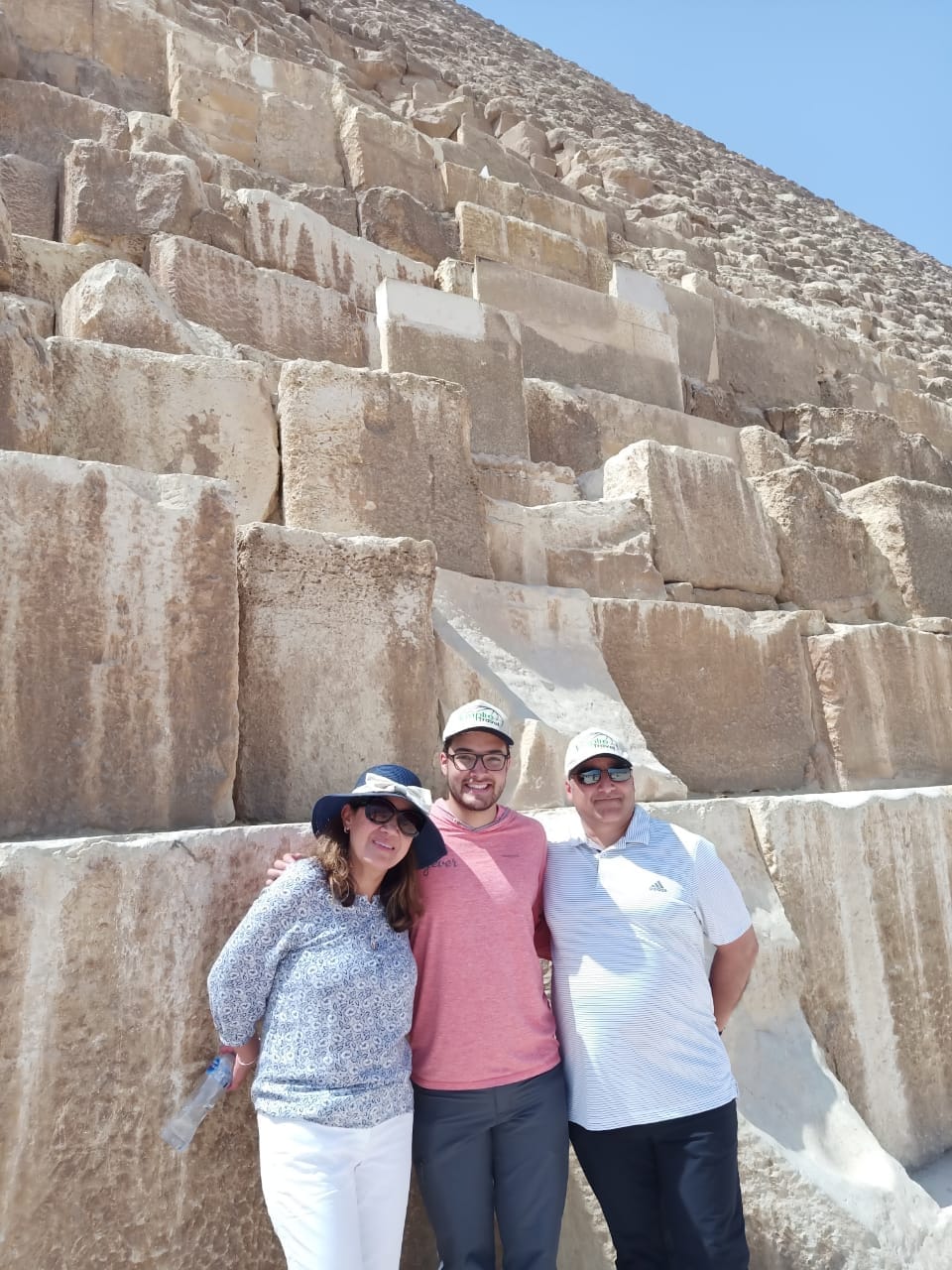
The Great Pyramid’s statistics are staggering by any measure. It consists of approximately 2.3 million limestone blocks, each weighing an average of 2.5 tons, though some granite blocks in the King’s Chamber weigh up to 80 tons. The base covers an area of about 13 acres, with each side measuring approximately 230 meters in length. The precision of its construction is remarkable; the sides are aligned almost perfectly with the four cardinal directions, deviating by less than four minutes of arc. This level of accuracy, achieved without modern instruments, continues to astound engineers and archaeologists alike.
Inside the Great Pyramid, visitors can navigate a complex network of passages and chambers. The entrance, located on the north face, leads to the descending passage that originally served as the main access route. The ascending passage branches off toward the Grand Gallery, one of ancient Egypt’s most impressive architectural spaces. This corbelled gallery rises at a steep 26-degree angle, its walls constructed with overlapping limestone blocks that create a dramatic 8.6-meter-high ceiling. At the end of this passage lies the King’s Chamber, where Khufu’s granite sarcophagus remains, though it was found empty when first entered by medieval explorers.
The pyramid also contains two other significant chambers: the Queen’s Chamber, located lower in the structure despite its misleading name (it likely had no connection to Khufu’s wife), and the unfinished subterranean chamber carved into the bedrock beneath the pyramid. Additionally, mysterious shafts extend from both the King’s and Queen’s Chambers, their exact purpose remaining one of Egyptology’s enduring puzzles—theories range from ventilation to astronomical alignment or symbolic passages for the pharaoh’s soul.
The Pyramid of Khafre: The Guardian’s Monument
The Pyramid of Khafre, built by Khufu’s son around 2570 BC, appears taller than the Great Pyramid when viewed from certain angles due to its elevated position on higher ground and steeper angle of inclination. In reality, it originally stood 143.5 meters tall, making it about three meters shorter than its predecessor. Today it measures approximately 136.4 meters in height. What makes Khafre’s pyramid particularly striking is that it retains a portion of its original smooth limestone casing at its apex, offering visitors a glimpse of how all three pyramids would have appeared in ancient times—gleaming white monuments that reflected the intense Egyptian sun.
The Pyramid of Khafre’s complex is the most complete of the three, featuring not only the main pyramid but also the remarkably well-preserved Valley Temple, the Sphinx Temple, and a causeway connecting these structures. The Valley Temple, built with massive limestone and granite blocks, served as the location for the pharaoh’s mummification and funeral rites. Its interior once contained 23 statues of Khafre, one of which—a magnificent diorite statue now housed in the Egyptian Museum in Cairo—ranks among ancient Egypt’s finest surviving sculptures.
The interior of Khafre’s pyramid is less complex than Khufu’s, featuring a simpler passage system that leads to a single burial chamber. Like its larger neighbor, Khafre’s pyramid was found empty, its treasures lost to ancient tomb robbers. However, the chamber itself remains impressive, carved from the living rock with a pointed limestone ceiling that echoes the pyramid’s outer form.
The Pyramid of Menkaure: The Divine Pyramid
The Pyramid of Menkaure, smallest of the three main pyramids at Giza, was built by Pharaoh Menkaure around 2510 BC. Originally standing 65 meters tall, time and stone robbery have reduced its height to approximately 61 meters. Despite its smaller size, Menkaure’s pyramid demonstrates no reduction in quality or ambition. Its lower courses were originally encased in red granite brought from Aswan, over 800 kilometers to the south—a tremendous logistical feat that underscores the resources ancient Egypt could mobilize for royal monuments.
The pyramid complex of Menkaure includes three smaller queens’ pyramids on its southern side, each originally encased in fine white limestone. Archaeological excavations have revealed beautiful statuary from Menkaure’s complex, including famous triads showing the king flanked by deities, now displayed in museums worldwide. The interior of Menkaure’s pyramid contains a descending passage leading to several chambers and a beautiful basalt sarcophagus (unfortunately lost at sea during its transportation to Britain in the 19th century).
The Great Sphinx: Guardian of the Plateau
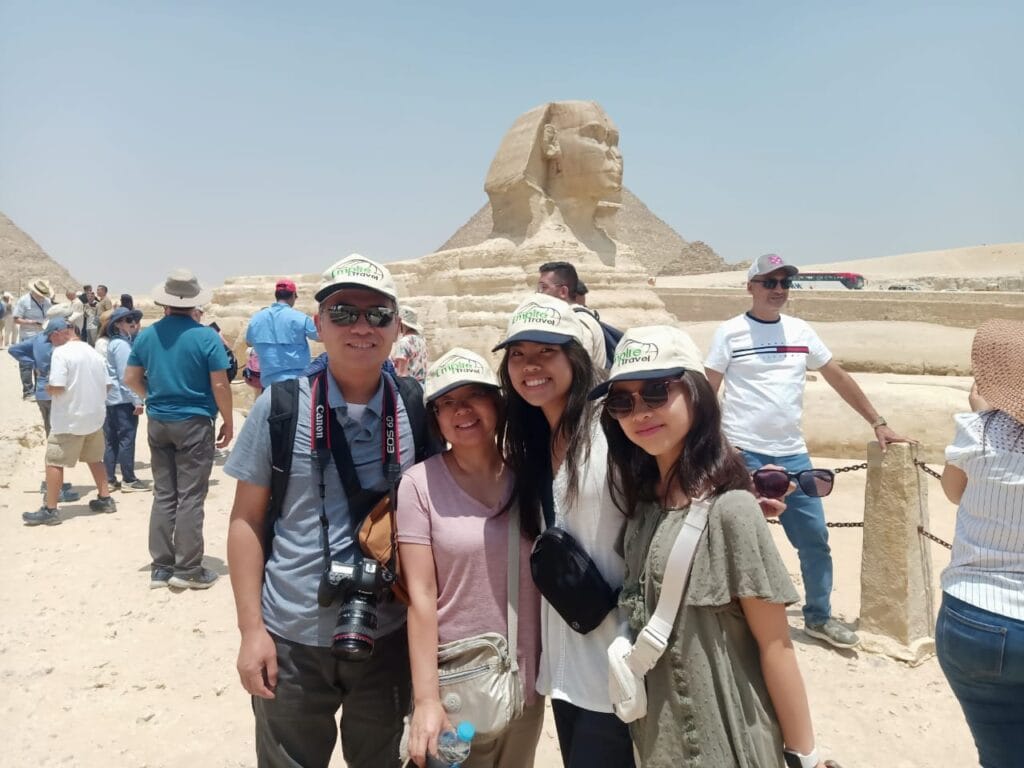
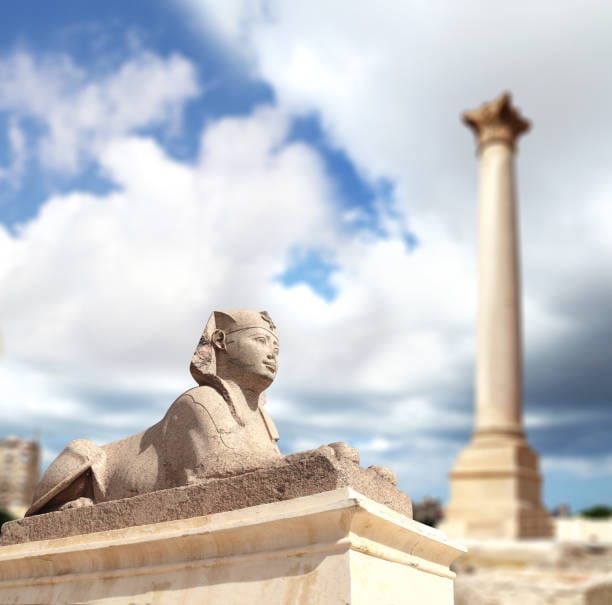
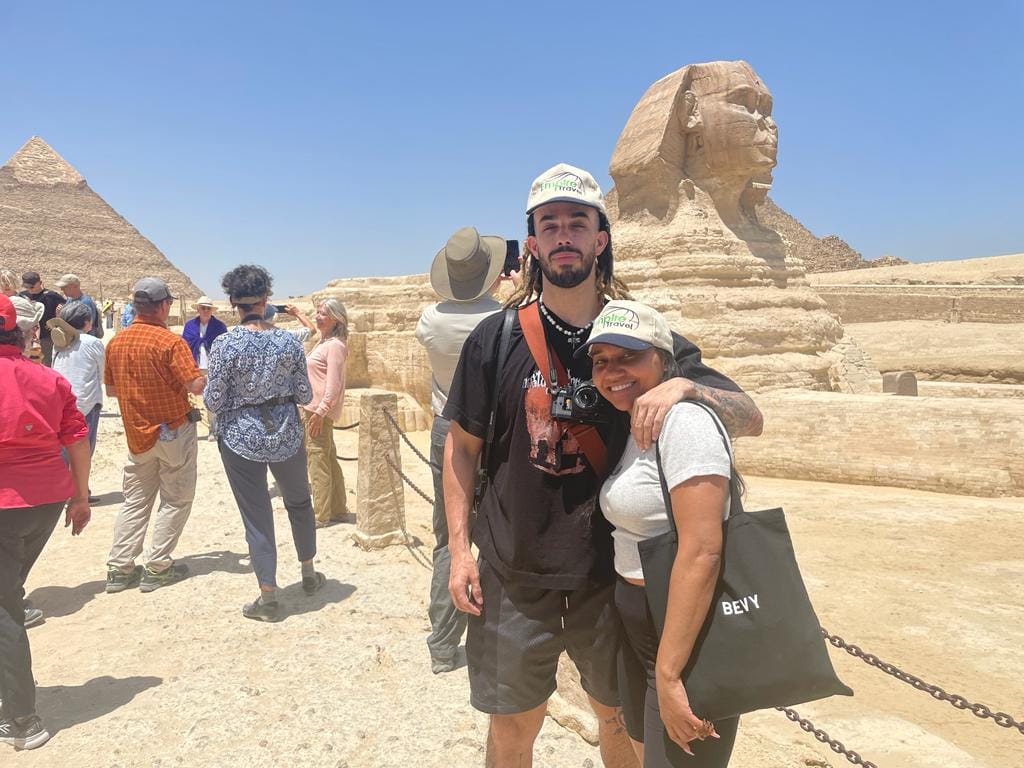
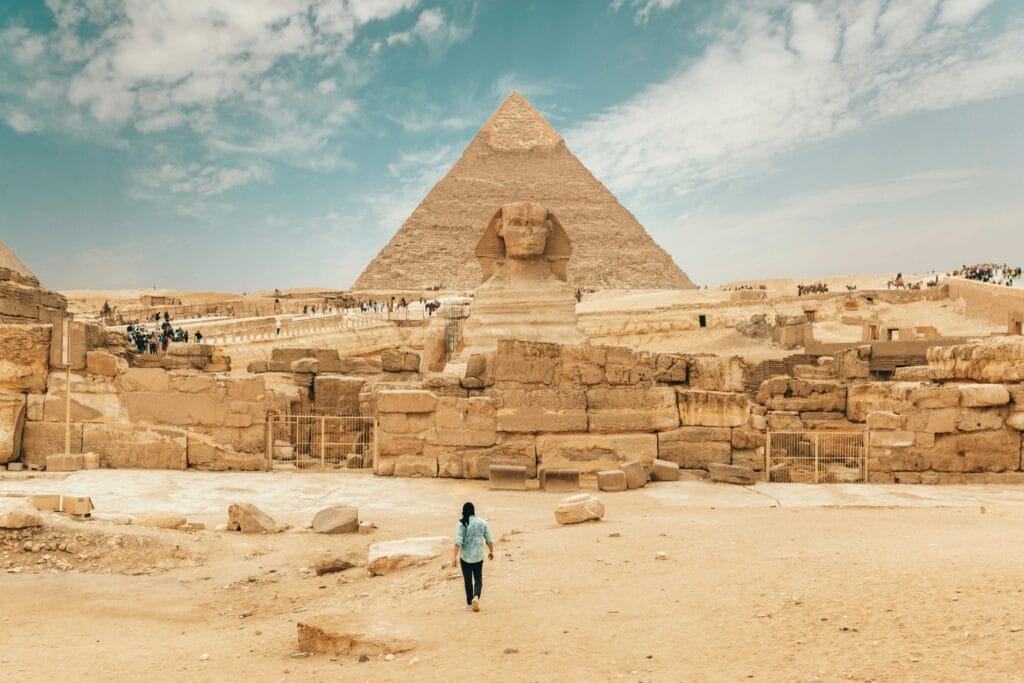
No visit to Giza is complete without contemplating the Great Sphinx, the massive limestone statue that has guarded the necropolis for millennia. Carved from a single outcropping of limestone rock, the Sphinx measures approximately 73 meters in length, 20 meters in height, and 6 meters in width. It combines a lion’s body—symbol of royal power—with a human head believed to represent Pharaoh Khafre, creating one of the world’s most recognizable monuments.
The Sphinx faces due east, welcoming the rising sun each morning. Between its massive paws lies the Dream Stele, erected by Pharaoh Thutmose IV in the 15th century BC, which recounts how the prince fell asleep in the statue’s shadow and dreamed that the Sphinx promised him the throne of Egypt if he would clear away the sand that had buried the monument. This inscription provides evidence that even in ancient times, the Sphinx was already considered ancient and mysterious.
Over the centuries, the Sphinx has undergone numerous restorations, as its softer limestone composition makes it vulnerable to erosion. Missing its nose (lost in medieval times, contrary to Napoleon-related myths) and ceremonial beard (fragments now reside in the British Museum and Egyptian Museum), the Sphinx nonetheless retains its powerful presence and enigmatic expression that has fascinated visitors throughout history.
Construction: Engineering Marvel of the Ancient World
The question of how the ancient Egyptians constructed the pyramids has fascinated scholars and laypeople alike for centuries. While many exotic theories have been proposed, modern Egyptology has pieced together a compelling picture based on archaeological evidence, ancient texts, and experimental archaeology. The consensus among researchers is that the pyramids were built by skilled Egyptian workers using copper tools, wooden sledges, ramps, levers, and an intimate knowledge of mathematics and astronomy.
Recent archaeological discoveries at workers’ villages near the pyramids have revealed that the builders were not slaves but paid laborers who lived in purpose-built settlements with bakeries, breweries, and medical facilities. These workers received wages in the form of food rations—primarily bread and beer—and were organized into crews with names like “Friends of Khufu” and “Drunkards of Menkaure,” suggesting a sense of pride in their monumental task.
The limestone blocks forming the pyramid cores were quarried locally from the Giza Plateau itself, while fine white limestone for the outer casing came from Tura, across the Nile. Granite used in internal chambers was quarried at Aswan and transported by boat during the Nile’s annual flood when water levels rose high enough to bring vessels close to the construction site. Workers likely used ramps—perhaps straight ramps, spiral ramps, or a combination of systems—to raise the massive blocks into position, though the exact configuration remains debated among scholars.
Planning Your Visit to the Pyramids of Giza
The Pyramids of Giza are located on the Giza Plateau, approximately 13 kilometers southwest of central Cairo. The site is easily accessible from most Cairo hotels, with the journey typically taking 30 to 45 minutes depending on traffic conditions. The pyramids are open daily from 8:00 AM to 5:00 PM, with extended hours during summer months. Arriving early in the morning or late in the afternoon offers the best experience, with fewer crowds, more comfortable temperatures, and optimal lighting for photography.
General admission to the Giza Plateau includes access to the exterior of all pyramids, the Sphinx area, and the general site. However, entering the interior of the pyramids requires separate tickets with limited daily availability. The Great Pyramid typically sees the longest queues, so visitors interested in exploring its interior should arrive early or book in advance through a tour operator. Inside the pyramids, expect narrow passages, steep climbs, and hot, confined spaces with limited ventilation—the experience is not recommended for those with claustrophobia or mobility concerns.
Beyond the pyramids themselves, the site offers numerous photo opportunities, including the panoramic viewpoint where all three pyramids align perfectly. Camel and horse rides are available for those seeking a traditional desert experience, though it’s essential to negotiate prices clearly before mounting. The Solar Boat Museum, located near the Great Pyramid, houses a reconstructed ancient wooden boat discovered in a sealed pit in 1954, offering fascinating insights into ancient Egyptian maritime technology and burial customs.
Evening brings a different dimension to the Giza experience with the Sound and Light Show, available in multiple languages. This hour-long spectacle uses dramatic lighting and narration to bring the pyramids’ history to life, with the ancient stones themselves seeming to speak of pharaohs, gods, and eternal mysteries. The show provides an excellent way to appreciate the monuments from a different perspective and learn more about ancient Egyptian civilization in an entertaining format.
The Enduring Mystery and Legacy
Despite centuries of study, the Pyramids of Giza continue to reveal new secrets. Recent technological advances, including muon tomography and thermal imaging, have detected previously unknown voids and chambers within the Great Pyramid, suggesting that these ancient monuments may yet hold undiscovered spaces. Each new discovery adds another layer to our understanding of ancient Egyptian capabilities and beliefs, while simultaneously generating new questions for future generations of researchers to explore.
The pyramids’ significance extends far beyond their archaeological and historical value. They represent humanity’s earliest monumental achievements in stone architecture, demonstrating sophisticated understanding of mathematics, astronomy, engineering, and logistics. They testify to ancient Egypt’s organizational capabilities—the ability to feed, house, and coordinate tens of thousands of workers over decades-long construction projects. Most profoundly, they embody the ancient Egyptian concept of eternal life, built to ensure their royal occupants’ successful journey to the afterlife and to preserve their memory for eternity.
For modern visitors, the Pyramids of Giza offer an unparalleled connection to the ancient world. Standing before these monuments, it becomes possible to appreciate not only their physical grandeur but also the vision, determination, and skill of the civilization that created them over four millennia ago. They serve as a powerful reminder of human capability and ambition, bridging the vast expanse of time between ancient Egypt and our present day.
Attraction Gallery
Frequently Asked Questions (FAQs)
The Great Pyramids of Giza were built around 4,500 years ago, approximately 2500 BC. The largest pyramid, the Great Pyramid of King Khufu, was constructed around 2550 BC and stands at an impressive 481 feet tall.
The pyramids were built as royal tombs for the pharaohs during Egypt’s Old Kingdom period. The most famous is the Great Pyramid of King Khufu (Cheops). They were constructed during the fourth, fifth, and sixth dynasties, representing the pinnacle of ancient Egyptian civilization before its collapse.
The construction methods remain one of history’s greatest mysteries. Despite their giant size, precise alignment, complex inner passages and chambers, and astronomical orientations, the exact techniques used remain debated. Even with modern technology, their construction seems incredible, leading to many theories about the building process.
The pyramids captivate us due to their enormous scale, precise mathematical alignments, complex internal chamber systems, and astronomical orientations. Their construction techniques, which achieved such precision without modern tools, continue to fuel speculation and research into ancient Egyptian capabilities.
The first pyramid is believed to be the Step Pyramid of King Zoser (Djoser) at Saqqara. Pyramid building increased dramatically during the fifth dynasty (2494-2345 BCE) and continued through the sixth dynasty (2345-2181 BCE).
The largest and most famous pyramid is the Great Pyramid of King Khufu, standing at 481 feet tall. It was built around 2550 BC and remains one of the most remarkable architectural achievements in human history.
The Great Pyramids are located in Giza, on the outskirts of Cairo, Egypt. They sit on the Giza Plateau and are easily accessible from Cairo, making them one of Egypt’s most visited attractions.
Yes, visitors can enter certain pyramids, including the Great Pyramid of Khufu. Inside, you’ll find narrow passages leading to burial chambers. Please note that the passages can be narrow, steep, and hot, and may not be suitable for those with claustrophobia or mobility issues.
Besides the three main pyramids (Khufu, Khafre, and Menkaure), you can see the Great Sphinx, the Valley Temple, smaller queens’ pyramids, and the Solar Boat Museum. The entire complex offers a comprehensive glimpse into ancient Egyptian royal burial practices.
Yes, almost anything we provide can be customized to your preferences.